

Recently, two breakfast programs welcomed special visitors. At Maillard Middle School in Coquitlam, BC, professional athletes and BCC ambassadors Lindsey Butterworth and Justin Kent served up breakfast to students. In Montreal, QC, chef and entrepreneur Geneviève Everell had the chance to visit a new program at Evangeline School.
Be sure to read our blog article to discover what happened and see the videos of their visits!
Maillard Middle School
Maillard Middle School has been a part of Breakfast Club of Canada since 2013, and youth worker Lisa Haines has been running the program for the last five years.
Like other coordinators, Lisa has had to adjust her service during the pandemic, changing it from a drop-in, sit-down breakfast in the cafeteria to a grab & go–style program. The excellent quality of her breakfasts hasn’t changed, however. Her students’ favourites are the fresh vegetable sandwich, filled with hummus, spinach, cucumbers, bell peppers and cheese, and the banana oat pancakes. Her secret is soaking the oats in milk overnight for a heartier texture, and the bananas are sweet enough that syrup is not needed at all. If there are any leftovers, students are welcome to grab a bag for a snack or for lunch.
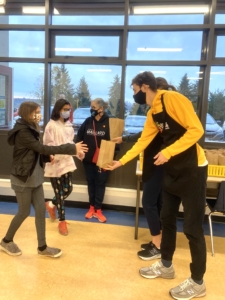
Lindsey and Justin had a great time visiting Maillard Middle School and connecting with some of the breakfast program’s enthusiastic regulars.
As ambassadors, Lindsey and Justin want to contribute to fundraising and promoting BCC’s values to provide youth with healthy nutritional opportunities and education.
“I have a passion for health promotion and a keen interest in advocating healthy behaviour through proper nutrition in youth. Learning about food security in my undergraduate degree and volunteering with the breakfast program at my local community centre really instilled the importance of access to a healthy breakfast in me. I want to continue to promote and increase accessibility to breakfast programs across the country with Breakfast Club of Canada.” Lindsey Butterworth
“I believe in the importance of equal opportunity for youth to have access to proper nutrition. Growing up in Surrey, British Columbia, an inner-city school system, I witnessed the positive impact of a breakfast program. I hope I can make a difference so that youth are properly fuelled to achieve their goals. No one should chase their dreams on an empty stomach.” Justin Kent
Watch this video to find out their reason for teaming up with us and why they believe in school breakfast programs.
Évangeline School
Located in the north end of Montreal, Évangeline School is home to over 800 senior high school students from a wide range of cultural backgrounds. In addition to mainstream classes, the school also offers specialized and vocational preparation programs for students with an autism spectrum disorder (ASD).
Starting in fall 2021, Samia Abbassa, a school staff member and the breakfast program site coordinator, has been there every morning to greet students from the regular program who begin to pour in at 7:30 a.m. She sets up in the cafeteria and serves breakfast to anyone who wants it. While she is catering to them, she is also preparing bins for the students in the ASD classes, who prefer to have breakfast in their own classroom, where any sensory issues are easier to cope with.
Every morning, a student from each of the ASD classes is tasked with picking up the breakfast food bin and later returning any leftovers to Samia, along with the reusable utensils to be washed. This kind of involvement in the breakfast program can represent a big step in developing students’ sense of responsibility. The benefits of the breakfast program are therefore twofold: it is an excellent source of nutrition and a solution for working through unique challenges.
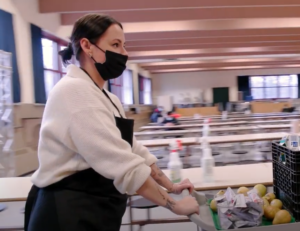
BCC ambassador Geneviève Everell recently went to visit students at Évangeline School, where she rolled up her sleeves to serve up a delicious breakfast to the teens.
Entrepreneur, author, franchisor, speaker and former BCC enrollee Geneviève Everell is the wiz behind Sushi à la maison. Hers is a truly remarkable story. The breakfast program she attended at elementary school helped mitigate the food insecurity she experienced at home.
“Your organization made such a huge difference in my life. I never thought one day I’d be able to say THANK YOU!” Geneviève Everell
Watch the video here (in French only).
This past October, our Club coordinators visited one of our recently opened programs for the first time. Annieville Elementary School in Delta, BC — the traditional territory of the Tsawwassen and Musqueam First Nations — started its program with Breakfast Club of Canada in fall of 2020.
Fast forward to a year later, and the program is now a well-oiled machine, involving school staff and local businesses to offer some morning cheer every school day.
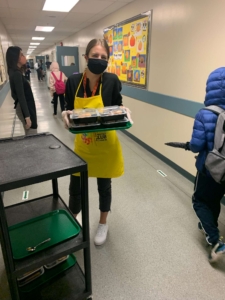
Each morning, youth worker Sara Glennon and education assistant Christine Mitzel pack individual breakfasts in reusable bento boxes, purchased last year with the Club’s equipment grant. Breakfasts are planned out in advance each week by Sara, who orders groceries online and picks them up every Monday.
The program makes sure no students are left out, including those requiring a gluten- or gelatin-free meal. Food is prepared in a separate area and served in different coloured boxes and serving trays to ensure there is no cross-contamination. Currently, breakfasts are delivered to classrooms, with teachers communicating the number of meals needed to make planning a breeze and ensure there is minimal waste.
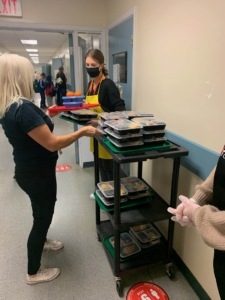
Collaboration is essential, according to principal Jann Kwasnicki, whose goal is to see this program run independently, regardless of who may be leading the school administration in the future. Once it is safe to do so, the team plans to use the multi-purpose room attached to the kitchen as the breakfast room, where they are hoping to make the atmosphere homelike and comfortable for students to enjoy a warm meal together, socialize and start their day off right.
This school year, Annieville Elementary has enlisted the support of the local Walmart, which has generously donated coolers to keep food cold before serving and has raised funds for the school. The Rotary Club of Tsawwassen also supports Annieville Elementary with their Starfish Backpack program, and local firefighters chip in with monthly snack food donations.
Thanks to the collective efforts of school staff and the local community, the students of Annieville Elementary can enjoy a nutritious and delicious breakfast each day.
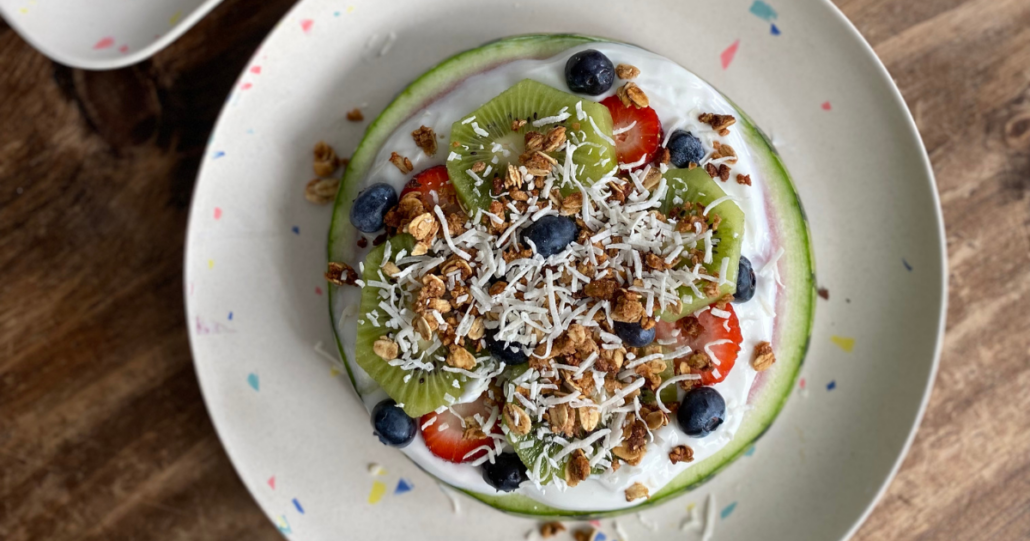
For Nutrition Month, Breakfast Club of Canada has teamed up with child nutritionist Mélanie Magnan (nutrimini.com) to bring you a simple, irresistible breakfast recipe that kids and parents alike are bound to love. One of Mélanie’s mantras is “Healthy eating should be fun.” Mission accomplished!
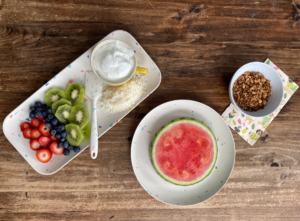
Photo credit: Nutrimini
Ingredients (for 1 pizza)
- 1 mini watermelon disc, about 8 inches (20 cm) in diameter, sliced approximately 1 inch (2.5 cm) thick
- ½ c. (125 mL) vanilla-flavoured Greek yogurt
- ½ kiwi, sliced
- 1 or 2 strawberries, sliced
- 12 a dozen fresh blueberries
- ¼ c. (60 mL) mixed granola
- 1–2 Tbsp. (15 mL–30 mL) desiccated coconut
Preparation
- Spread half of the yogurt on top of the disc.
- Top with kiwi, strawberries and blueberries.
- Sprinkle granola and coconut over top.
- Serve with the remaining yogurt on the side.
For more delicious and nutritious recipes, visit our recipes sections!
Follow Nutrimini on her social media!
Looking to avoid food waste in your breakfast program? Want to ensure that your fruits and veggies stay fresher and tastier for longer? Here are eight great ideas on how to make the most of your produce!
- Remove any elastic bands from your vegetables after buying them. They can damage and break vegetables, especially leafy ones.
- Remove leaves from your root vegetables (radishes, carrots, parsnips, beets, etc.). Leaves tend to absorb all the water and decrease the shelf life of root vegetables.
- Punch holes in the plastic wrap of vegetables that come in trays to let them breathe. You may have noticed that the plastic wrap on mushrooms, for example, is already perforated. This helps prevent them from becoming slimy.
- Put your bananas in the fridge before they are too ripe. Their peels may turn black, but the fruit inside will stop ripening. You can make delicious banana slices now or store them in the freezer for subsequent use.
- Freeze your leftover fruit and use it later. Any fruit can be frozen. Tip: Spread the fruit or fruit pieces out on a large baking sheet and put in the freezer for an hour. Then transfer to an airtight container to store. This way, the individual pieces will freeze separately, so if you need a certain quantity, you won’t have to defrost the whole batch. Frozen fruit can be added to yogurt, porridge, muffins, smoothies — anything!
- Add lime or lemon juice to your fruit salad to keep it fresh. This will stop the fruit from browning and keep your salad appetizing.
- Put a paper towel at the bottom of berry containers to absorb moisture. This will increase the shelf life of your berries and prevent the formation of mould.
- Freeze any “ugly” fruit and make compote out of it when you have enough. This works with apples, pears, peaches, berries or an assorted mix! Check out our cookbook for a simple berry compote recipe that can easily be adapted to any fruit you have on hand.
In early April, schools across Canada joined our Virtual Gathering Place, an online platform where they could share their successes and challenges in incorporating Indigenous foods and practices into breakfast and other meal programming. Participants also touched on ways to honour the values and communities of the tradutional territories within which their programs operate. Three main topics were covered: challenges and solution; cultural practices and interconnectedness of food, and recipe sharing.
Successes
There were many challenges shared, ranging from time and space within the school community to prepare meals, to food safety regulations and student preferences. However, along with these came many innovative solutions:
- Reducing preparation time:Schools had great ideas to share to help cut down on prep time in the mornings, like baking bannock in a large sheet pan and slicing it into pieces with a pizza cutter. Many foods can also be prepared ahead of time in large batches and stored in the freezer, then warmed up in the morning. Bannock, for example, can be prepared the day before. Slightly toasting or heating it up the next day can restore the soft, delicious texture we know and love.
- Sourcing Indigenous foods:Many schools have found great success in sourcing Indigenous foods through community connections. For example, family or community members who are hunters can provide access to a good supply of meat. Connecting with Elders to gather, harvest or hunt together is also a source of inspiration. Inviting community members or Elders into the school to help make bannock and teach students how to prepare it is another way to introduce traditional foods into your program. Some schools also put out a call to the local community for donations of any meats, foods or produce. Finally, community gardens are a great way to bring foods into your program while maintaining and leveraging local connections.
- Food safety regulations:It is important to consider and follow the food service regulations relevant to your school. Within these regulations, some schools have created a permission form for wild meat when students register, and others have found success purchasing through a local butcher, as the meat is packaged and date-stamped to meet certain requirements.
- Introducing students to new foods:Breakfast coordinators have had success introducing unfamiliar foods by including students in the harvesting or preparation process through community gardens or cooking classes. Inviting Elders or Knowledge Keepers to talk to students about what they ate growing up can also help bridge the gap.
Cultural Practices, Language and Interconnectedness of Foods and Culture
Using language, valuing togetherness and honouring the ceremony around eating can be great solutions for representing Indigenous ways of knowing and being in your breakfast program. Schools shared with us how they bring singing, language, art and communities together with school events, announcements and classes.
Many schools are limited in time or resources to incorporate Indigenous foods into their daily breakfast program. Hosting a community-wide meal is one idea for incorporating traditional foods and practices. Involving members of the community to help cook foods like bannock or salmon soup is a great way to get the positive energy going. Other school events, like Métis Week or Indigenous Celebration Day, can also be used to get students to try traditional foods and talk about their heritage and families. Some schools hold outdoor cookouts, where students can make bannock on a stick over an open fire, and teachers and community members can share their specialties, like fishing, and harvesting and preparing wild meat. Other ways that some schools have incorporated language and cultural practices into their breakfast programs include announcing the daily breakfast menu in Cree and gathering every morning with singing, drumming and round dancing during breakfast. Another school including learning Cree for students during beading classes.
Kicking off Your Breakfast Program and Recipe Sharing
Some easy recipe ideas to get you started: why not work wild berries into different breakfast dishes? Saskatoon berries, blueberries and other berries can be used in smoothies or parfaits, or served with bannock, pancakes or oatmeal. Fresh summer berries can be preserved by making compote or jam to enjoy all year round.
Bannock can also be served in many ways, including breakfast pizza, breakfast sandwiches, breakfast tacos, French toast or with chili and stew. Try using a blend of whole wheat and white flour, or adding oats or ground oat flour to your bannock, to increase its nutritional value.
Some other ideas:
- Reach out to Nations in your area for recipes
- Ask students and their families to share recipes
- Google or search the local library for a cookbook with local traditional recipes
- Start a “Bannock of the Month” activity and have students bring in their own family recipes
- Hold an outdoor cookout and invite local community members
- View the list of resources from trusted stakeholders that we have compiled here.
The Virtual Gathering Place was a part of our dedication to supporting each program’s unique reality, in this case, the focus on an Indigenous worldview. It was also a way to participate in reconciliation. We hope to continue developing our support for traditional and Indigenous foods and to provide more resources for our schools. We are grateful to have learned from the over 160 schools in attendance.
It’s hard to believe that summer is quickly approaching and breakfast programs will soon be winding down! In preparation for this hiatus, consider the following tips to use up any ingredients you have left or to store food properly over the summer months.
5 Tips to Use What You Have Left Before Summer
- Plan — Find recipes that use the ingredients you have on hand. For example, you can make pancakes with leftover applesauce and oats. If you have extra eggs, why not whip up some breakfast sandwiches!
- Adapt — Swap the fruits or veggies called for in a recipe with what you have. You can do this with other ingredients as well, such as different types of flour or oil.
- Make smoothies, sauces and compotes — They are the perfect way to use leftover fruit! Freeze any fruit that hasn’t been eaten at the end of each breakfast. When you have enough set aside, throw it into a smoothie, sauce or compote.
- Hold a theme day or celebration breakfast — It will help you use up ingredients in new recipe and menu ideas!
- Cook big batches and freeze them — In order to buy less food as summer approaches, cook big batches and freeze them. You’ll see your inventory of fresh ingredients get smaller and smaller as you do.
Don’t forget to use your egg coupons before summer, too!
If you’re not able to use everything before school ends, think about ways to store food properly:
- Milk and yogurt can be frozen. This may affect their texture, but they are still safe to consume and can be used in smoothies and baking.
- Cheese can be frozen, either whole or grated. Ensure that it is well wrapped or sealed to maintain quality.
- Vegetables can be blanched and frozen. Place in boiling water for 1 to 3 minutes, then remove with a slotted spoon and plunge into ice cold water. Open freeze as explained below.
Open freezing allows you to store fruits and veggies without them clumping together. This also allows you to use only the amounts you need without having to defrost a whole batch. Open freeze fruit and blanched veggies by spacing them out on a non-stick or parchment-lined baking sheet. Place in the freezer until solid, then transfer to freezer-safe bags or containers. Don’t forget to label them clearly, complete with the date!
Saint-Charles School is a small school in the scenic Saguenay–Lac-Saint-Jean region of Quebec. They set up a breakfast program for their 75 students a little more than a year ago. Special education teacher Myriam Servais is the one who got the initiative off the ground, with support from her fellow staff members. “Madame Myriam,” as she is affectionately known, is in tune with the needs of her students. From day one, she has put her all into making the program a success, so that every child can start their morning with a wholesome breakfast.
This year, some extra help was needed to keep everything running smoothly, so the breakfast program decided to reach out to the parent population. Marie-Soleil Aupin-Keighan, a mother of one of the students and a very creative person by nature, responded immediately. As someone bursting with ideas for recipes, decorations, crafts and more, she was the perfect fit for the role of site coordinator. So she decided to take the plunge!
Thanks to the efforts of all the volunteers and the staff members who help out, the breakfast program at Saint-Charles School is a hive of activity every morning. Students from Grades 5 and 6 are also on hand to pitch in with breakfast preps. “Without all these great people, I’d have much less time to plan, organize and cook!” said Marie-Soleil.
It turns out Marie-Soleil is also a wiz at cutting down on food waste: “I work hard to keep waste to a minimum. I’ll inevitably find a way to turn one thing into something else or invent new no-bake recipes to get students to eat food they may otherwise turn their nose up at. I make energy balls and apple sauce popsicles. When yogurt gets close to its best-before date, I freeze it and make yogurt pops. Unopened drinkable yogurt gets put into a blender with frozen fruit to make smoothies. And that’s just the beginning!” This week, she’s testing out a new egg spread. We’re sure that, like everything else she dreams up, it will be a huge hit!
She has generously agreed to share one of the kid-tested recipes she has come up with. Feel like giving it a whirl?
MARIE-SOLEIL’S NO-BAKE ENERGY BALLS
Yield: 32 balls
Ingredients:
- 2 c. (500 mL) soy butter* (WowButter)
- 1 c. (250 mL) granola
- ⅓ c. (80 mL) honey or maple syrup
- ¼ c. (60 mL) raisins
Preparation:
- Line two cookie sheets with parchment paper or a reusable silicon mat.
- Combine the soy butter and honey with an electric mixer or a fork.
- Add the granola, using your fingers to crumble some of the bigger pieces. Blend together with a mixing spoon.
- Shape the mixture into balls, about 1 Tbsp. (15 mL) at a time. If it is too sticky to handle, try moistening your hands with a little water. Add extra soy butter and honey if needed for the balls to hold together.
- Place them on the prepared cooking sheets, making sure they don’t touch. Chill for at least an hour.
N.B.: For special occasions, drizzle melted chocolate over top, as illustrated.
*You can substitute other nut or seed butters if that’s what you have on hand!
Maverick School joined Breakfast Club of Canada in December 2021. See what their principal, Jayne Nicholson, has to say about their daily breakfast program.
What is the one thing people need to know about your breakfast program?
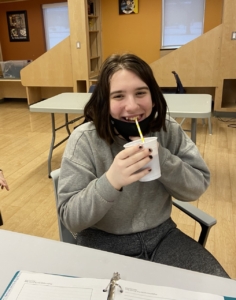
The most important thing you need to know about our breakfast program is that students are truly appreciative of the opportunity to enjoy breakfast when they arrive at school! They LOVE smoothies!
What are you most proud of in your breakfast program?
I’m most proud of how the program has been streamlined. Students order their breakfast through a Google Chat with our breakfast program coordinator, and food is delivered right to students’ work area. This began because of COVID, but I think we will keep it in place as it is time-efficient and there is no food waste! I’m also proud and grateful that the additional funds have allowed us to ensure food security over school breaks in the form of food hampers containing non-perishable breakfast items.
Is there a student/school staff/community member who has gone above and beyond in your breakfast program?
I’d like to give a shout-out to Alisa Meyer, our coordinator. Lis is kind, caring and efficient! She knows that students value her work, and she is always eager to try new breakfast items to expand our menu and provide variety. On Fridays, she creates a breakfast casserole, pancakes or French toast as a special treat. She is mindful of the budget and keeps our kitchen shiny clean. Our breakfast program is in capable and caring hands. Thank you, Lis!
Special breakfasts: What do students look forward to?
SMOOTHIES! Wow, do they love smoothies! Our smoothies contain a variety of fruits, greens and Greek yogurt to make sure that hit of protein is part of their morning meal. They also love breakfast wraps.
Have students asked for specific foods? What are they? Any interesting, unique requests?
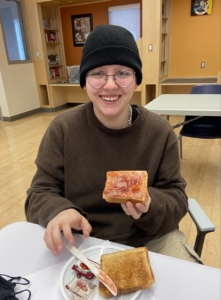
We have not had requests for specific foods. Everyday breakfast items include fruit and yogurt, whole wheat toast, oatmeal, low-sugar cereals and, of course, smoothies!
The desire to give back can start at any age, as 7-year-old Béatrice can tell you. Hers is a story of humble beginnings that lead to big achievements!
How it All Started
In 2021, Béatrice and her friends Annabella and Zoé decided to sell lemonade to raise money for Breakfast Club of Canada and give other kids an equal chance to succeed. The idea then grew and grew, with six school friends, siblings and children from the neighbourhood joining in on the fun. With the help of their parents, the small group of young entrepreneurs pulled the whole thing off admirably, bringing in the tidy sum of 5.
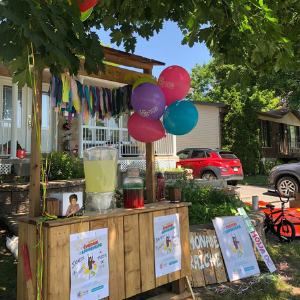
The beautiful lemonade stand created specially for the occasion!
A New Year, a New Goal!
This summer, the group decided to repeat the experience, only with a loftier goal in mind.
Even more of their friends, brothers and sisters decided to pitch in as well, as did their parents, who built a lemonade stand, spread the word on social media and put up signs in the neighbourhood.
A Perfect Day
The sale ended up happening on a warm, sunny afternoon in mid-July, in a specially made wooden lemonade stand. Béatrice and her teammates, Mathias, Florence, Abygaëlle, Massoma, Zoé, Annabella, Lee-Anne, Anaëlle and Édouard, went all out, making and hanging decorations, putting up BCC-themed balloons and greeting thirsty customers.
Lots of people stopped by, intrigued by what was going on and happy to make a donation in exchange for a refreshing glass of lemonade. The great weather meant that the stand could stay open until 7 p.m.
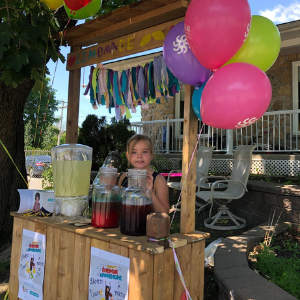
Béatrice, 7 years old, ready to sale lemonade!
Proud parents
This year’s efforts definitely paid off, raising ,282 to help Breakfast Club of Canada feed children throughout the year.
The parents who helped out were very proud and touched to see their children lend a hand to such a worthy cause. Maxime and Mélissa, Béatrice and Mathias’s parents, told BCC that they were already talking about doing it again next year — bigger and better than ever!
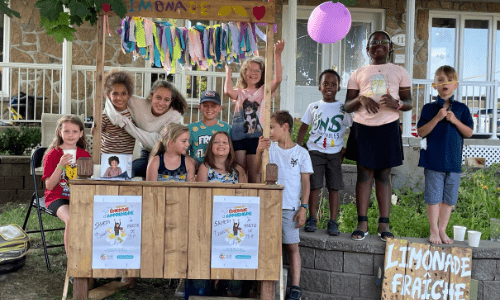
From left to right: Annabella, Anaëlle, Lee-Anne, Béatrice, Florence, Isaac, Abygaëlle, Édouard, Massoma, Zoé and Mathias.
Everyone here at Breakfast Club of Canada would like to thank and congratulate Annabella, Anaëlle, Lee-Anne, Béatrice, Florence, Isaac, Abygaëlle, Édouard, Massoma, Zoé, and Mathias, as well as all those who supported them, for doing such a wonderful job again this year. It is inspiring to see children take the lead on initiatives like this that let them make a real difference in the lives of other children their age.
See you again next year, we hope!
Welcome back, students! Welcome back, teachers! AND let’s not forget the support staff, volunteers and all those who make your school’s breakfast program possible! Collaboration is often the key to a successful program and we are grateful to see so many hard-working individuals on the ground at every school serving up breakfast. Remember, YOU are Breakfast Champions!
In the spring, we were thrilled to see so many schools take part in the Club’s Breakfast in Unison event. Your participation created a wave of recognition for all our Breakfast Champions from coast to coast to coast. In June, Jocelyn Dudley, one of our program coordinators, was lucky enough to attend a virtual Breakfast in Unison with Riverside Public School in Prince Albert, Saskatchewan. The event highlighted the contributions of six staff members who graciously prepare and serve breakfast daily. It was also an opportunity to acknowledge and express gratitude to two community partners, Save-On-Foods Prince Albert and the Prince Albert Food Bank. During the event, we heard from students and teachers about the importance of the daily breakfast program.
Here are some quotes that were shared.
From students:
“It helped us taste different things we haven’t had before.”
“It got rid of the rumble in my tummy.”
“It helped me wake up a little bit more.”
“It made me not talk loud and concentrate on my work and be good.”
“When you eat food, it makes you big and strong.”
From teachers:
“A lot of my students rely on this food program. Breakfast first thing in the morning creates happy students with full tummies and full hearts ready to learn. There would be more setbacks in behaviour if students were hungry.”
“I can say that when my students are not hungry, they are more willing to participate in class activities! They almost all come to school without breakfast. They are hungrier and they often ask for that second snack in the afternoon. I appreciate the food very much!”
“Parents often comment that they appreciate the provided breakfast and snacks for students, especially with the rising cost of groceries. For many of the children, they either do not have enough in their lunch kit to fill them up or the food they do have provides limited nutritional value.”
A daily school breakfast makes a difference in the lives of these students, teachers and families, and it takes collaboration to make it happen! We encourage you to integrate recognition into your day-to-day and annual calendars. It is never too early to start planning to celebrate your school’s Breakfast Champions! Keep an eye out in upcoming newsletter articles to learn more about creating a culture of recognition in your program.
Back to school also overlaps with apple picking season. Try this super simple and no bake “apple pie” recipe submitted by Coldwater School in Merritt, BC, as a fun way to welcome students back — they’ll love it! If you have some leftover summer peaches or any other fruit, why not give those a whirl instead? Use your creativity to add your own flair.
Apple pie
In individual cups or bowls, place nut-free granola on the bottom. Add sliced or diced apples and top with yogurt.
“Simple, easy and the students love it.” – Coldwater School in Merritt, BC
Call for recipes
We’d love to hear from you! Do you have any recipes you’d like to share? Send your favourite cultural, traditional, unique or easy-to-make dishes to testimonials@breakfastclubcanada.org and you could be featured in one of our future newsletters or on our website. All submissions will also be entered into a draw to win some sweet BCC swag!
Whole vegetables and fruits are an essential part of a healthy diet and offer many nutritional benefits over their liquid counterparts, which often contain added sugar and salt.
Here are a few more reasons you should serve them instead of juice for breakfast:
- They contain fibre: Fibre plays an important role in naturally controlling your appetite. Most of the fibre in a vegetable or fruit is found in its peel and pulp. When these are removed, as they are with juice, the benefits of the fibre are lost.
- They are chock-full of vitamins and minerals: Whole vegetables and fruits are complex foods that are rich in vitamins and minerals from root to stalk. By eating all the edible parts, you’ll be getting the most out of every nutrient.
- The sugar and salt they contain are naturally balanced: Think of the last time you squeezed an orange. How much juice did you get out of it? Barely enough to fill the bottom of a glass, right? So you can imagine how many it would take for a full serving! The result is very high in sugar (the same sugar content as a soft drink!) and does not make you feel full. What’s more, many commercial fruit juices contain added sugar, and many vegetable juices contain salt, which is a shame because vegetables and fruits in their natural state are already bursting with flavour.
All in all, there really is no comparison between whole vegetables and fruits and juice, be it store-bought or freshly pressed. No matter how you serve whole vegetables and fruit — fresh, frozen, canned, stewed or blended — be sure to work as many of them as you can into your breakfast menu. They are as versatile as they are colourful, making the first meal of the day appealing to the eye as well as the taste buds. Use them to introduce your students to a world of flavours and textures.
Visit our Recipes section for more tricks and information!